



 SEO Services
 Local SEO
 ecommerce SEO
 Free SEO Audit
 Content Writing
 Google Review Management
 Google Penalty Recovery









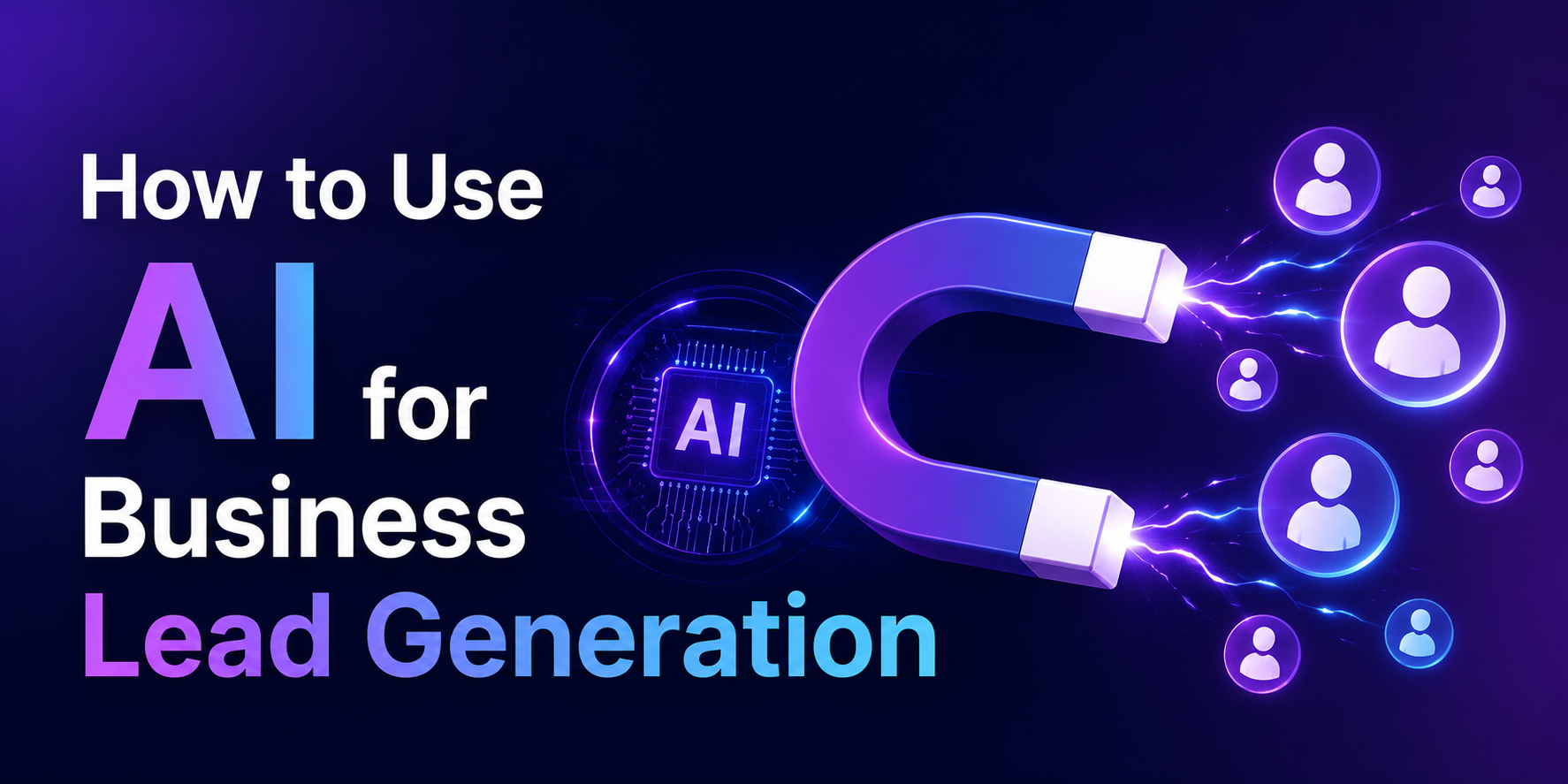
The most reliable way to use AI for business lead generation is to map your full customer journey first, then apply AI to the specific step that is leaking the most leads, rather than bolting AI onto every stage at once. This guide walks through a ten-step framework covering traffic, conversion, response, qualification, nurture, booking, sales support and measurement, with a worked Australian example so you can see exactly where AI helps and where a person needs to stay in charge.
What “AI lead generation” means in practice
AI lead generation is the use of AI tools to identify, attract, capture, qualify and follow up with potential customers faster and more consistently than a fully manual process allows. It typically combines better-targeted content, faster response times, automated but reviewed follow-up, and clearer prioritisation of which leads deserve attention first.
A related term is AI business automation: using software, often AI-assisted, to carry out repeatable business tasks (sending a confirmation, scoring a lead, drafting a follow-up email) without a person doing every step manually, while a person still sets the rules and reviews the output.
Neither term describes a single tool. Both describe a way of organising work across the tools you already use, plus a small number of new ones chosen deliberately for the job at hand.
The ten-step AI lead-generation framework
Work through these steps in order the first time. After that, revisit whichever step is currently your biggest bottleneck.
Step 1: Define a valuable lead and the commercial outcome
Before adding any automation, agree internally on what a genuinely valuable lead looks like for your business: the service or product, the budget range, the location, and the urgency that predicts a good outcome. Without this definition, AI tools have no basis for scoring or prioritising anything, and “more leads” can quietly become “more unqualified enquiries.”
Write this down as a simple one-page brief: ideal customer profile, disqualifying signals, and the commercial outcome you’re optimising for (a booked job, a signed contract, a completed sale). Every later step refers back to this document.
Step 2: Map the current customer journey and identify leakage
Walk through your own funnel as a customer would: search, land on a page, decide whether to enquire, submit a form or call, wait for a response, get qualified, receive follow-up, and eventually buy or walk away. At each step, note roughly how many people drop off and why, using analytics where you have it and honest observation where you don’t.
This step matters because AI applied to the wrong part of the funnel wastes effort. A business losing most leads to slow phone response doesn’t need a smarter chatbot; it needs faster response. Mapping the journey tells you which of the following steps to prioritise.
Step 3: Improve traffic quality through SEO, local search and paid campaigns
Traffic quality determines how much qualification work needs to happen after a visitor reaches your website.
Strong on-page SEO, accurate Google Business Profile information and tightly targeted advertising campaigns can attract visitors who are closer to making a buying decision.
That reduces pressure on every later stage of the funnel.
AI can assist by:
- Grouping related keywords
- Identifying search themes
- Preparing content outlines
- Comparing competitor topics
- Drafting advertising variations
- Summarising campaign data
- Highlighting possible optimisation opportunities
However, the underlying marketing fundamentals still need to be correct.
Your website must be indexable, useful and technically sound. Your business information must be accurate, and your content must genuinely answer what potential customers are searching for.
Businesses requiring support with organic visibility can explore Verve Innovation’s professional SEO services.
Companies serving particular suburbs, cities or service areas should also invest in local SEO services to improve Google Maps visibility, local landing pages and business-information consistency.
For immediate search visibility, carefully managed Google Ads campaigns can bring targeted visitors to high-converting service or landing pages.
No AI feature replaces these foundations.
Step 4: Strengthen landing pages, forms and calls to action
A visitor who arrives with intent can still be lost to a slow-loading page, a confusing form, or a call to action that doesn’t match what they were searching for. Before adding AI-assisted capture tools, check the basics: page load speed on mobile, a form that asks only for what you need at this stage, and a CTA that reflects the visitor’s likely next question.
AI tools can help draft alternative page copy and CTA wording for testing. However, layout, loading speed, accessibility and technical performance remain website optimisation tasks rather than AI tasks.
A professionally planned business website design can help connect search visibility, landing-page clarity and lead capture within one conversion-focused experience.
Step 5: Use AI-assisted chat or forms to capture context without creating friction
Once the page itself is solid, AI-assisted chat or smart forms can capture useful context, service needed, location, timing, without forcing a visitor through a long form upfront. Done well, this shortens the gap between interest and a usable enquiry.
Keep the assistant’s scope narrow and clearly disclosed as an assistant, escalate anything outside its confidence to a human quickly, and never let it make a commitment (a price, an appointment guarantee) it isn’t authorised to make.
Step 6: Respond rapidly through CRM, email and SMS automation
Response speed is one of the highest-leverage points in the entire funnel. An automated, immediate acknowledgment (by SMS or email) confirming that a real person will follow up, combined with a genuinely prompt human callback, consistently outperforms a slower, purely manual process.
This is a good early automation target for most Australian small businesses: the acknowledgment can be simple and automated, but the promised follow-up window has to be something your team can reliably meet.
Step 7: Score and route leads using transparent rules
Once leads are coming in and being acknowledged quickly, use the ideal customer profile from Step 1 to build simple, explainable scoring rules, budget signals, service fit, location, timing, urgency, rather than an opaque black-box score nobody on the team can explain to a customer or to each other.
Review scoring rules against actual sales outcomes every few weeks. If a lead type your rules mark as low priority keeps converting well, the rule needs adjusting, not the sales team’s judgement.
Step 8: Equip sales with account research, call summaries and follow-up drafts
AI can meaningfully speed up the sales conversation itself: summarising a discovery call into key points and next steps, drafting a first version of a follow-up email or proposal based on notes, and pulling together background on a prospect’s business before a call.
Every commercial detail in an AI-assisted draft, pricing, scope, timelines, needs to be checked by the salesperson before it reaches a customer. AI drafts the starting point; a person is accountable for what actually gets sent.
Step 9: Measure cost per qualified lead, appointment rate, close rate and revenue
Track the funnel in commercial terms, not just traffic and click metrics: cost per qualified lead, enquiry-to-appointment rate, appointment-to-close rate, and revenue per lead source. This is what tells you whether an AI-assisted change actually improved outcomes rather than just changing activity.
Connect the source, the article or channel, the keyword theme, and the CTA used to your CRM (GoHighLevel or equivalent) so this attribution survives past the first touchpoint.
Step 10: Run human-reviewed tests and improve one bottleneck at a time
Treat every change, a new automation, a new scoring rule, a new chat flow, as a test with a clear before-and-after measure, reviewed by a person before and after it goes live. Improve the single biggest bottleneck identified in Step 2, measure for four to six weeks, then move to the next one.
This is slower than trying to fix everything at once, and it is also the difference between an AI lead-generation system that compounds over time and one that becomes an unmanageable pile of half-tested automations.
Worked example: a Melbourne local service business
Consider an electrical services business operating across several Melbourne suburbs. Here is how the ten steps play out end to end, with the point where AI assists and the point where a person must stay in control made explicit at each stage.
| Stage | What happens | Where AI assists | Where a person is essential |
|---|---|---|---|
| Search & arrival | A visitor searches “electrician [suburb]” and lands on a suburb/service page. | AI-assisted keyword clustering informed the page structure during content planning. | The page content and pricing information were written and verified by the business. |
| Conversion | The visitor uses a short form asking for suburb, job type and urgency, or calls directly. | An AI-assisted chat widget answers a quick availability question if the visitor hesitates before filling in the form. | The chat widget escalates anything about pricing or safety to a real staff member. |
| Immediate confirmation | The visitor receives an SMS confirming the enquiry and a callback window. | The SMS is sent automatically the moment the form is submitted. | The business has committed to, and consistently meets, that callback window. |
| Qualification | The enquiry is scored using job type, suburb and urgency against the business’s ideal-job profile. | Scoring is applied automatically using the rules the business defined. | A dispatcher reviews any enquiry the rules mark as borderline. |
| Follow-up | A staff member calls within the promised window to confirm details and provide a quote range. | AI drafts a suggested talking-point summary from the form data before the call. | The actual conversation, quote and commitment are handled by a person. |
| Booking | The job is scheduled directly into the business’s calendar. | Booking automation offers available time slots based on real technician availability. | Capacity rules are set and checked by the business, not assumed by the software. |
Nothing in this example depends on an exotic or unproven AI feature. Every step uses widely available automation tools connected sensibly to a genuine, fast human process.
Choosing tools without overcomplicating the stack
General AI assistants such as ChatGPT, Google Gemini, Microsoft Copilot, Anthropic Claude and Perplexity are useful for drafting, summarising and research throughout this framework, and several now offer web search with citations for current information. For the automation-heavy steps (response, scoring, booking, nurture) a CRM or marketing automation platform with built-in AI features, rather than a general assistant used manually, is usually the better fit because it can act on triggers in real time.
When comparing options, weigh up data sensitivity (can customer details go into this tool safely), integration with your existing CRM and calendar, the governance process for reviewing AI output, and whether the cost is justified by the volume of leads passing through that step.
Common mistakes that stall AI lead-generation projects
- Automating before mapping the funnel. Without Step 2, it’s easy to automate a stage that was never the real bottleneck.
- Treating lead scoring as a black box. If nobody on the team can explain why a lead was scored a certain way, the rules need to be simpler, not more sophisticated.
- Promising response times the team can’t meet. An automated confirmation is only useful if the human follow-up behind it is genuinely reliable.
- Skipping the measurement step. Activity metrics (emails sent, chats handled) are not the same as commercial outcomes (qualified leads, closed revenue).
- Changing several things at once. This makes it impossible to know which change actually improved, or hurt, results.
- Publishing Unreviewed AI Content. AI can accelerate research and drafting, but inaccurate, generic or repetitive content may damage trust and search performance.Professional SEO content writing services can combine keyword research and AI-assisted workflows with human writing, fact-checking and quality control.
Signs your business needs this framework now
Not every business needs to overhaul its lead process immediately. A few reliable signals suggest the ten-step framework above will pay off quickly:
- Enquiries sit unanswered for more than a few hours, especially outside business hours or on weekends.
- Your team can’t say with confidence which leads are worth calling first.
- Marketing spend is increasing but the sales team says lead quality is getting worse, not better.
- Follow-up happens inconsistently, some leads get three calls, others get none, depending on who picked them up.
- Nobody can currently tell you the cost per qualified lead by channel.
If two or more of these sound familiar, start with Step 2 (mapping the journey) this week, even before choosing any tool.
A practical 30-60-90 day rollout
Businesses that succeed with this framework tend to sequence it rather than attempt it all at once. A realistic rollout looks like this:
| Timeframe | Focus | Typical outcome |
|---|---|---|
| Days 1-30 | Define the ideal lead (Step 1), map the funnel and identify the single biggest leak (Step 2), fix the most obvious technical or page issue (Steps 3-4). | A documented funnel map and a clear, agreed priority for automation. |
| Days 31-60 | Implement rapid response automation (Step 6) and basic lead scoring (Step 7) around the priority identified in month one. | Faster, more consistent response and a first version of lead prioritisation the team trusts. |
| Days 61-90 | Add nurture sequences, sales support tools (Step 8) and proper attribution reporting (Step 9), then formally review results against the baseline from Step 2. | A measurable before-and-after comparison and a clear decision on what to automate next. |
This pace feels slow to teams eager for quick wins, but it consistently outperforms trying to implement all ten steps simultaneously, because each stage is properly measured before the next one is layered on top.
Privacy and compliance considerations for Australian businesses
Any AI-assisted step that touches customer data, chat transcripts, CRM enrichment, call summaries, needs to be checked against the Australian Privacy Principles before it goes live, not after. Three practical checks matter most:
- Know where customer data goes. Check the data-handling terms of any AI tool before customer names, phone numbers or job details are entered into it, particularly free consumer-grade tools not built for business use.
- Be transparent about automation. If a visitor is chatting with an AI assistant or receiving an automated SMS, that should be reasonably clear, not disguised as a person when it isn’t.
- Keep a human decision point for anything consequential. Declining a job, quoting a price, or making a commitment to a customer should always have a person accountable for the final call, even if a draft was AI-assisted.
These checks take little time to build into a process from the start, and considerably more time to retrofit once a tool is already handling live customer data.
Matching tools to each step
| Framework step | Typical tool category | Key selection factor |
|---|---|---|
| Traffic quality (Step 3) | SEO research tools, ad platforms, AI writing assistants | Accuracy of research; human edit before publishing |
| Landing pages & CTAs (Step 4) | Website builder/CMS, AI copy assistant | Mobile performance and clarity of the next step |
| Capture & chat (Step 5) | AI-assisted chat/live chat widget | Clear escalation rules; disclosed as an assistant |
| Response (Step 6) | CRM with SMS/email automation | Reliability of the human follow-up behind it |
| Scoring & routing (Step 7) | CRM scoring rules or automation platform | Rules a person can explain, not a black box |
| Sales support (Step 8) | Call-summary tools, AI drafting assistants | Every commercial detail checked before sending |
| Measurement (Step 9) | CRM reporting, analytics dashboards | Attribution tied to source, article and CTA |
Why AI can’t fix a weak offer or unclear positioning
It’s worth stating plainly: none of the ten steps above will meaningfully help a business whose core offer is unclear, overpriced relative to the market, or poorly differentiated from competitors. AI speeds up execution across an existing process, it captures enquiries faster, follows up more consistently, and frees up staff time. It does not manufacture demand for a business that hasn’t solved a genuine customer problem, and it won’t turn an average service into a compelling one. Get the offer and positioning right first; then this framework multiplies the return on that foundation.
How this differs from a traditional sales funnel
The stages in this framework, attract, convert, respond, qualify, nurture, book, sell, measure, are not new. What changes with AI is the speed and consistency at several specific points: research that used to take a day can take an hour, a response that used to happen the next morning can happen within minutes, and a scoring process that used to rely on one experienced staff member’s gut feel can be documented and applied consistently across a whole team.
What doesn’t change is the underlying logic of a good funnel: relevant traffic, a clear offer, a fast and trustworthy response, and a genuine reason for a prospect to choose your business over a competitor. Businesses that treat AI as a replacement for that logic, rather than an accelerant for it, tend to be disappointed with the results.
Frequently asked questions
Where should a small business start if it can only automate one step?
For most service businesses, Step 6 (rapid response through SMS or email automation) delivers the fastest, most measurable improvement, because slow response is one of the most common and most costly leaks in the funnel.
Does this framework require an enterprise CRM?
No. Most steps can be implemented with a mid-market CRM or marketing automation platform that supports basic triggers, scoring rules and SMS/email sequences. The framework describes the process, not a specific piece of software.
How do I know if an AI sales funnel claim is realistic?
Be cautious of promises of guaranteed lead volume or guaranteed close rates from any “AI sales funnel” product. AI can improve speed and consistency in the funnel above, but conversion still depends on genuine demand, a competitive offer and reliable follow-through by your team.
How long does it take to see results from this framework?
Most businesses see an improvement in response time and lead qualification within the first 30 to 60 days, since these are largely process and automation changes. Improvements in close rate and revenue take longer to show clearly, usually a full sales cycle or two, because they depend on enough volume passing through the improved process to be measurable.
Can this framework work for a business that sells B2B rather than to consumers?
Yes, with adjustments. B2B lead cycles are usually longer and involve more people in the buying decision, so Steps 8 and 9 (sales support and measurement) tend to matter more, and nurture sequences in Step 6 typically run longer with more educational content rather than a quick booking prompt.
Do I need to hire someone to manage this, or can existing staff run it?
Most small businesses start by having an existing marketing or operations person own the framework part-time, using off-the-shelf CRM and automation features rather than custom development. A dedicated hire or agency support usually becomes worthwhile once lead volume or the number of active automations grows enough that part-time attention isn’t sufficient.
Next step
If you want an outside view on where your funnel is losing leads and which of these ten steps would make the biggest difference, request a lead-generation system review and Verve Innovation will map your current process against this framework, identify the highest-impact bottleneck, and outline a realistic 30-60-90 day plan to fix it. Prefer to start with the content and SEO side of the funnel first? Read our guide to 15 practical AI marketing use cases for small business, or get in touch to talk through where you’re currently losing leads.