



 SEO Services
 Local SEO
 ecommerce SEO
 Free SEO Audit
 Content Writing
 Google Review Management
 Google Penalty Recovery





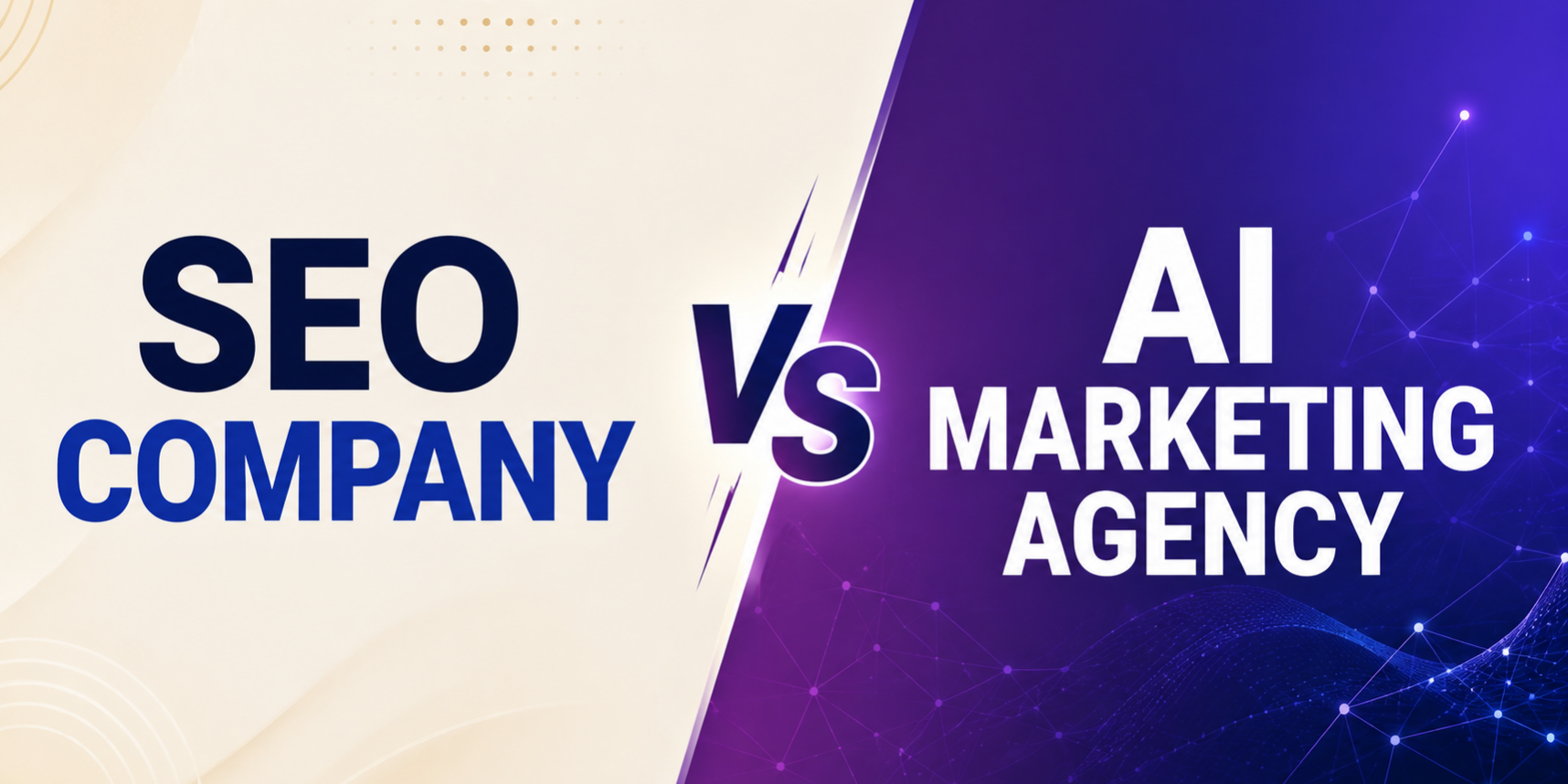
Most established Australian businesses don’t need to choose between an SEO company and an AI marketing agency: they need strong SEO foundations plus carefully selected AI marketing capabilities, working as one connected growth system rather than two competing services. This guide breaks down what each type of provider actually does, when to invest in which first, and how to build a practical decision framework for your own business.
Rejecting the false choice
Search visibility, paid media, conversion and follow-up work best when they’re connected, not run as separate, uncoordinated projects. An SEO company builds the discoverability and trust foundation a business needs across search engines and increasingly AI-assisted search. An AI marketing agency (or capability) speeds up research, content production, personalisation, lead qualification and follow-up. Treating these as an either/or decision usually means underinvesting in whichever one gets skipped, and both matter for consistent lead generation.
Verve Innovation operates as an SEO-led digital marketing agency that uses AI responsibly to improve research, production, personalisation, automation and decision-making, rather than positioning AI as a replacement for SEO fundamentals.
What an SEO company should actually do in 2026
A genuine SEO company’s core responsibilities haven’t changed as dramatically as some marketing suggests. The fundamentals remain:
- Technical health: Ensuring your site is indexable, fast on mobile, free of crawl errors, and structured with accurate schema markup.
- Content strategy: Producing original, useful content that answers real customer questions completely, built around genuine keyword and search-intent research.
- On-page optimisation: Clear titles, headings, internal linking and structured information that helps both search engines and readers understand a page quickly.
- Authority building: Earning legitimate backlinks, citations and mentions that signal trustworthiness to search engines.
- Local search: For businesses with a physical presence, maintaining accurate, consistent Google Business Profile and local citation information.
- Measurement: Tracking rankings, organic traffic, and, most importantly, the enquiries and revenue that traffic converts into.
Businesses that need to improve these foundations can explore Verve Innovation’s professional SEO services.
What has changed in 2026 is the need to consider how the same technical, content and authority signals support visibility in AI-assisted search. These developments add another layer to SEO rather than replacing its established foundations.
What an AI marketing agency should actually do
A genuine AI marketing capability, whether from a dedicated agency or built into a broader digital marketing partner, focuses on using AI tools to speed up and improve specific marketing and sales tasks:
- Research acceleration: Faster customer, market and competitor research to inform strategy.
- Content production support: AI-assisted drafting and repurposing, always with human fact-checking and editorial review before publication.
- Personalisation: Tailoring messaging, offers or follow-up based on what’s known about a specific lead or customer segment.
- Lead qualification and routing: Automated, rules-based scoring that gets the right leads to the right person faster.
- Follow-up automation: SMS, email and chat-assisted response that reduces the time between enquiry and human contact.
- Reporting and decision support: Automated anomaly detection and recommendations that help a business react faster to performance changes.
AI-assisted content should not be published without human review. Businesses that need original, search-focused material can combine AI-supported research with professional SEO content writing services.
None of these AI capabilities replaces the need for a website that ranks, a clear commercial offer or a sales process that converts. AI accelerates the execution surrounding those foundations.
Businesses exploring the available platforms can also read Verve Innovation’s guide to the best AI tools for Australian small businesses.
SEO vs AI marketing: a direct comparison
| Factor | SEO company | AI marketing agency/capability |
|---|---|---|
| Primary objective | Organic search visibility and discoverability | Speed and consistency in marketing and sales execution |
| Typical channels | Organic search, local search, increasingly AI-assisted search | CRM, email, SMS, chat, paid ad testing, internal research and reporting |
| Time horizon | Medium to long term; compounding value over months and years | Often faster to implement; value realised in weeks for specific workflows |
| Strengths | Durable, cost-efficient traffic; builds long-term authority and trust | Speed, consistency, and scale for well-defined, repeatable tasks |
| Limitations | Takes time to build; doesn’t guarantee immediate leads | Doesn’t create demand or fix a weak offer; requires human oversight |
| Measurement | Rankings, non-brand organic traffic, organic-sourced enquiries | Response time, qualification accuracy, conversion rate, cost per qualified lead |
When SEO should be the first investment
SEO should generally come first when a business has:
- Little or no organic search visibility
- An outdated or technically weak website
- Thin, duplicated or unhelpful content
- Inconsistent business information across online directories
- Poor local search visibility
- Limited non-paid website traffic
- No clear keyword or search-intent strategy
Without a foundation of discoverability and trust, AI-assisted marketing tools have less traffic and fewer qualified leads to work with.
A perfectly automated follow-up system provides limited value when very few potential customers are discovering the business through search.
Businesses serving defined suburbs, cities or service areas should pay particular attention to local SEO services, including Google Business Profile optimisation, local landing pages and citation consistency.
When AI automation should be added
AI automation earns its investment once a business has reasonable traffic and enquiry volume but is losing value through slow response times, inconsistent follow-up, or manual processes that don’t scale with demand. At this stage, AI-assisted response, qualification and nurture typically deliver a faster, more measurable return than further SEO investment alone, because the traffic already exists; it just isn’t being converted efficiently.
How Google AI Overviews and AI Mode change discovery without making SEO obsolete
Google’s AI Overviews and AI Mode are built on the same core Search ranking and quality systems used for standard results. A page generally still needs to be well-optimised and eligible to rank normally before it has a chance of appearing as a supporting link within an AI-generated summary. This means AI-assisted search discovery adds a new presentation layer on top of existing search infrastructure, it doesn’t replace the underlying need for a technically sound, genuinely useful, well-optimised website.
How ChatGPT Search, Gemini, Copilot, Claude and Perplexity create additional discovery pathways
Beyond Google, several AI assistants now provide live web answers with citations: ChatGPT Search uses OpenAI’s dedicated OAI-SearchBot to index content for its search features; Google Gemini can draw on Google’s broader ecosystem and web information depending on the feature; Microsoft Copilot can ground responses using Bing web search; Anthropic Claude offers web search with citations for queries needing current information; and Perplexity positions itself specifically as an AI-powered search engine with citations and links. Each of these represents an additional discovery pathway that depends on the same underlying requirement: content has to be crawlable, genuinely useful, and worth citing.
Red flags to watch for
Be cautious of agencies making any of the following promises, none of which align with how these platforms actually work:
- Guaranteed rankings, guaranteed AI citations, or guaranteed lead volumes within a fixed timeframe.
- “Instant AI rankings” achieved through a proprietary technique not documented by any major platform.
- Mass-generated pages or AI-written content published without genuine editorial review and fact-checking.
- A single “AI SEO” package that replaces, rather than integrates with, ongoing technical and content SEO work.
- Reluctance to explain, in specific and verifiable terms, what technical or content changes they’re actually making.
A practical decision framework for Australian SMEs
- Audit your current visibility. Check your organic search rankings, traffic, and whether your Google Business Profile and citations are accurate and consistent.
- Audit your current conversion process. Map how quickly enquiries are answered, how leads are qualified, and how consistently follow-up happens.
- Identify the bigger leak. If visibility is weak, prioritise SEO. If visibility is reasonable but conversion and follow-up are inconsistent, prioritise AI-assisted automation.
- Build one connected plan. Whichever you start with, plan for the other to follow within a realistic timeframe rather than treating them as unrelated projects.
- Set shared measurement. Track enquiries, qualified leads and revenue by source so you can see how SEO and AI-assisted marketing contribute together, not just in isolation.
A Verve example: SEO and automation working together
A useful way to see this in practice is a business that had reasonable organic traffic to its service pages but a slow, inconsistent enquiry response process. Strengthening SEO further would have added incremental traffic, but the bigger opportunity was in the existing traffic that was already arriving and not being converted efficiently. Adding rapid, automated acknowledgment and consistent human follow-up to the existing SEO-driven traffic improved enquiry-to-appointment conversion meaningfully faster than additional content investment alone would have. This illustrates the core argument of this article: the two disciplines solve different problems, and sequencing them correctly, based on where the business is actually losing value, matters more than picking one over the other.
How Verve combines SEO, AI visibility, paid media, web conversion and CRM follow-up
Verve Innovation’s approach starts with a technical and content SEO foundation, extends into AI-assisted search visibility practices (entity clarity, structured information, crawl access for AI-specific bots), and connects that visibility to paid media, website conversion optimisation and CRM-based follow-up so that traffic from every channel is captured, qualified and followed up consistently. The goal is a single connected system rather than a stack of disconnected services, with human strategy and editorial oversight at every stage.
A checklist Verve uses when deciding what a client needs first
Before recommending a starting point, it’s worth running through the same practical checklist we use internally when assessing a new client:
- Does the business rank for its core service and location terms on page one of Google? If not, technical and content SEO is almost always the priority.
- Is Google Business Profile information (name, address, phone, categories, hours) accurate and consistent across all listings? Inconsistent business information undermines both traditional and AI-assisted search visibility.
- What percentage of enquiries receive a response within one business hour? Below roughly 80%, rapid response automation is usually the highest-leverage investment available.
- Is there a documented, consistent lead-scoring approach, or does prioritisation depend on whoever picks up the enquiry first? Inconsistent qualification is a strong signal that automation would help.
- Is existing content genuinely answering customer questions completely, or is it thin, outdated, or duplicated across similar pages? Weak content limits the ceiling of any SEO or AI-visibility investment.
- Does the business have reliable attribution connecting enquiries back to source, channel and keyword theme? Without this, it’s difficult to justify further investment in either discipline with confidence.
A business that scores poorly on the first two questions should prioritise SEO. A business that scores well there but poorly on the response and qualification questions should prioritise AI-assisted automation. Most established businesses need meaningful work in both areas over time.
A note from Verve’s Head of SEO
“The businesses that get the best results treat this as sequencing, not selection,” says Verve’s Head of SEO. “We’re not choosing SEO or AI marketing for a client, we’re figuring out which one is currently the bigger constraint on growth, fixing that first, and then bringing the other online once there’s enough traffic or enough process maturity for it to make a real difference. Agencies that pitch one as a replacement for the other are usually optimising for what’s easiest to sell, not what a specific business actually needs right now.”
Budget allocation: a practical starting point
There’s no universal split that fits every business, but a reasonable starting approach for an Australian SME with a modest existing digital marketing budget is to weight investment toward whichever discipline scored worse in the checklist above, roughly 60-70% of budget toward the priority area and the remainder toward maintaining the other, then rebalancing every quarter as the priority area matures. A business investing heavily in SEO with zero attention to response time and follow-up is leaving value on the table from traffic it has already earned. A business investing heavily in automation with no organic visibility is optimising a funnel that has too little traffic entering it to matter.
Common misconception: “AI marketing agencies don’t need to understand SEO”
Some agencies position themselves purely as “AI marketing” specialists, distinct from SEO providers. In practice, several of the highest-value AI marketing use cases, content briefs, keyword and search-intent research, content refresh and repurposing, directly depend on SEO expertise to be done well. An AI marketing capability that doesn’t understand search intent, keyword research or content structure will produce automation that looks efficient but doesn’t actually improve qualified organic traffic. This is one of the clearest practical arguments for an SEO-led agency that has genuinely integrated AI capabilities, rather than a standalone AI marketing provider working in isolation from search strategy.
Glossary of terms used in this comparison
- SEO (search engine optimisation): The practice of improving a website’s visibility in organic (unpaid) search results through technical, content and authority-building work.
- AI marketing: The use of AI tools to support research, content production, personalisation, lead qualification, automation and decision-making within a marketing and sales process.
- Generative engine optimisation (GEO): An emerging term for practices that make content easier for AI-assisted search features to find, understand and cite; built on the same fundamentals as traditional SEO.
- Lead qualification: The process of assessing whether an enquiry matches a business’s ideal customer profile closely enough to prioritise for immediate follow-up.
- Cost per qualified lead: A measurement of total marketing spend divided by the number of leads that meet an agreed quality bar, used to compare the efficiency of different channels or investments.
What this decision looks like over a 12-month period
For a business starting with weak SEO and no automation, a realistic sequence over a year might involve the first quarter focused on technical SEO fixes and a content plan, the second quarter adding rapid response and basic lead scoring once new organic traffic starts arriving, the third quarter layering in nurture sequences and sales support automation, and the fourth quarter reviewing full-funnel attribution to decide where the next year’s investment should concentrate. This sequencing avoids the common failure mode of investing heavily in both disciplines simultaneously without enough measurement discipline to know what’s actually working.
How this plays out across different business types
The right starting point varies meaningfully by business type. A multi-location medical or dental practice typically has strong underlying demand but loses value through slow response and inconsistent booking, making rapid response automation and appointment-booking integration a high-priority early investment alongside ongoing local SEO maintenance. A trades or home-services business often has similar dynamics, plus a strong case for SMS follow-up on missed calls given how much of that industry’s enquiry volume arrives by phone. A newer professional-services firm with limited existing visibility usually needs to prioritise foundational SEO and content first, since there isn’t yet enough traffic for automation to meaningfully improve. An established e-commerce or multi-location retail business often benefits from parallel investment, ongoing SEO to defend and grow category rankings, alongside AI-assisted personalisation and customer service automation, because both traffic and conversion volume are already large enough to justify concurrent investment.
This is why a generic “SEO vs AI marketing” recommendation isn’t useful without understanding a specific business’s current visibility, conversion process and industry dynamics first.
Frequently asked questions
Is it more cost-effective to start with SEO or AI marketing?
It depends on where your business is losing the most value today. A business with strong traffic but poor conversion will typically see faster returns from AI-assisted response and follow-up. A business with weak visibility will typically need SEO investment first, since there isn’t enough traffic yet for automation to meaningfully improve.
Can one agency genuinely do both well?
Yes, provided the agency treats AI marketing as an extension of a solid SEO and digital marketing foundation rather than a separate, disconnected specialty. Ask any prospective agency how their SEO and AI marketing work is coordinated, not just what each team does independently.
How long before I see results from combining both?
AI-assisted automation improvements (faster response, better qualification) are often measurable within four to six weeks. SEO improvements typically take longer, often three to six months, to show clearly in rankings and organic traffic, though this varies by competitiveness and starting point.
Will an AI marketing agency eventually make SEO unnecessary?
No credible evidence supports this. AI-assisted search features are themselves built on indexed, crawlable web content, meaning SEO remains the supply chain for both traditional and AI-assisted discovery. Businesses that stop investing in SEO risk losing visibility across every discovery channel, not just traditional search.
What size business should consider working with both an SEO company and a separate AI marketing provider?
For most small and medium Australian businesses, working with a single agency that coordinates both disciplines is more practical than managing two separate vendors, since it avoids duplicated strategy work and ensures consistent measurement. Larger businesses with dedicated internal marketing teams may have more capacity to manage specialist providers separately.
Does switching between an SEO-focused and an AI-focused provider create risk?
Switching providers frequently, especially between SEO and AI marketing specialists who don’t coordinate with each other, tends to create inconsistent strategy, duplicated onboarding costs, and gaps in measurement continuity. Where possible, working with a single accountable partner who coordinates both areas, or at minimum ensuring your providers actively communicate with each other, produces more consistent results than treating the two as entirely separate vendor relationships.
Questions to ask before signing with either type of provider
Whether you’re evaluating an SEO company, an AI marketing agency, or a combined provider, a short set of direct questions tends to reveal how genuinely capable they are: What specific outcome will change in the first 90 days, and how will it be measured? Which of my existing pages, listings or processes will you touch first, and why those? How do you handle human review of anything AI-assisted before it reaches a customer? What happens to results if I stop working with you, does the value compound (as good SEO typically does) or does it disappear immediately (as some automation setups do without ongoing management)? Agencies that answer these specifically and can point to a documented process are generally a safer choice than those relying on confident but vague reassurance.
Next step
If you’re unsure whether your business needs stronger SEO foundations, better AI-assisted conversion, or both, book a complimentary SEO and AI visibility review and Verve Innovation will help you identify the highest-impact starting point. Prefer to understand the practical AI use cases first? Read our guide to 15 practical AI marketing use cases for small business.